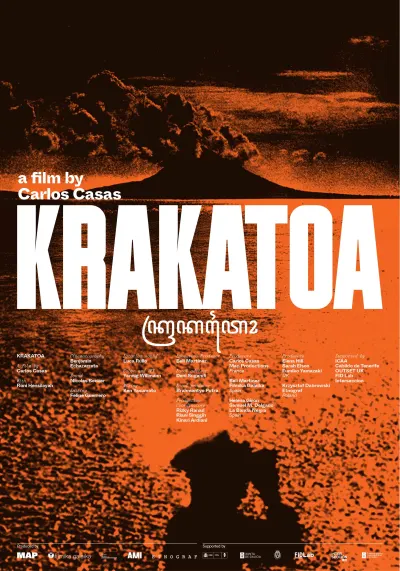
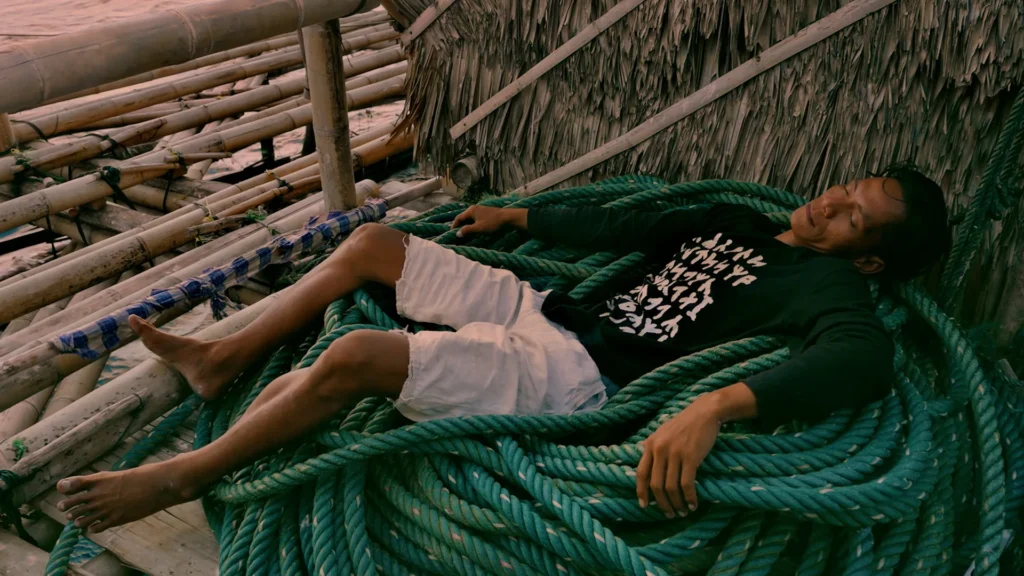
Kesuma, a young fisherman from Bagan who lives on a bamboo platform near Krakatoa, mends his nets after a night without catching a fish. Little does he know that disaster is about to strike. A colossal eruption and tsunami devastate everything, leaving him stranded on a deserted island. Searching for water and food, he travels along arid coastlines and through lush jungles, encountering strange life forms. Taking refuge in a cave, he embarks on a hallucinatory journey through geological eras, rivers of lava, and landscapes that defy all perception, venturing ever deeper into the earth's depths.
Roni Herliansyah, an Indonesian fisherman, survived the 2018 tsunami triggered by the Krakatoa volcano in the Sunda Strait, between Java and Sumatra. The wave killed 437 people, including his friends, and left him adrift for five days. The film is his return to the sea, to the shipwreck, to the disaster. Without dialogue, it unfolds like a dream, in which Roni recreates part of what happened. Slowly, the story of the disaster transforms into the mythical tale of the castaway. A hybrid work by director Carlos Casas, 'Krakatoa' is the second installment of a trilogy about sound. It seeks to induce the viewer to embark on a journey alongside the protagonist, a psychedelic and experimental descent inspired by the films of Stan Brakhage, to the center of the Earth.
Mao Osorio, FIDOCS 30 Programming Assistant