


Driven by curiosity, people crowd around the camera in a busy Santiago location. It's clear the reporter is a foreigner. "You can't talk here," someone exclaims. "It's fear, everyone's afraid," says another. But they don't remain silent, despite the risk, and plead: "Say it outside." This documentary is a snapshot of Chile after two years of military dictatorship. With the agitational rhetoric typical of the Cold War and characteristic of H&S Studios, it portrays both regime representatives and the victims of terror, who begin to organize while searching for the detained and disappeared.
The film includes historic footage of the bombing of La Moneda Palace, the first interview with General Augusto Pinochet after the coup, and recordings of political prisoners in the concentration camp. Despite constant surveillance, the filmmakers managed to conceal their true purpose through various strategies, such as using the pretext of filming landscapes to promote tourism or documenting the economic success of Pinochet's government.
This film was restored by the DEFA Foundation in 2026, 50 years after its premiere.
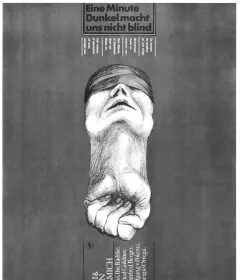
‘'A minute of shadow does not blind us: we shall not die with any agony,' wrote Pablo Neruda in the poem 'The Episode' included in 'Critical Sonata', the fifth volume of 'Memorial de Isla Negra' (1964). This documentary by H&S Studio, founded by Walter Heynowski and Gerhard Scheumann in the German Democratic Republic, takes its title from these verses. Together they developed a cinema of protest, dedicating a series of films to the Chilean political process, the coup d'état, and the dictatorship.
Under the guise of producing a tourism and economic report, a team sent from West Germany, comprised of Gerhard Biroth, George Boultwood, and the Brazilian Frederico Füllgraf, risked everything to film covertly in Chile during 1975, two years after the start of the dictatorship. Released in Europe in 1976, the film portrays a country gripped by fear and repression. Through statements from authorities, official archives, and the voices of those searching for their disappeared relatives, the documentary reveals the contradictions of a regime that attempted to project an image of normalcy while spreading terror.
Featured in the retrospectives that FIDOCS dedicated to Heynowski and Scheumann in 1999 and 2000, this documentary forms part of the Festival's backbone. Fifty years after its premiere, it returns for our thirtieth edition in a newly restored version. Revisiting these images means reaffirming cinema as a tool for memory and highlighting the work of international filmmakers who helped to document and denounce the horrors of the dictatorship.
Martín Castillo Fort, artistic director FIDOCS 30
Walter Heynowski (1927, Ingolstadt – 2024, Berlin) and Gerhard Scheumann (1930, Ortelsburg, East Prussia – 1998, Berlin) were the best-known and most influential documentary and propaganda filmmaking duo in the German Democratic Republic (GDR). They began their careers as television journalists and founded Studio H&S in 1967. They filmed extensively in Vietnam, Kampuchea, and Chile, the latter being the subject of 12 of the 71 films in their filmography. These works were the most successful and profitable of their 26 years of collaboration. The fall of the Berlin Wall distanced them from the public eye. Scheumann died in 1998. In 2001, Heynowski visited Chile to present a film series and was received at La Moneda Palace by President Ricardo Lagos; he died in 2024.
Peter Hellmich (1927–2020). Little is known about his birthplace, family background, or education, but from 1967 he was the principal cinematographer for numerous Heynowski & Scheumann documentaries, which focused on anti-imperialist themes and international political conflicts. He also co-directed several films about Chile. He held West German citizenship (Federal Republic of Germany). His involvement with the production team was under an exceptional agreement that included special privileges. There is no reliable public information about his life after 2002 or the circumstances of his death in 2020.